When Cypriot Greeks and Turkish Cypriots speak about what has happened in Cyprus, Greek Cypriots select and highlight the landing of the Turkish army on Cyprus in July 1974 as the most traumatic event for their community during the course of Cyprus problem. The war of 1974 massively traumatised Cypriot Greeks. However, the most traumatic event for Cypriot Turks was a long lasting anxiety that existed for many years. For a very long time Turkish Cypriots lived with this anxiety and the continued hope that one day Turkey would save them.
For me, my personal trauma started in 1956 when I was a little girl and was forced to witness my Greek friends emptying the village called Louroujina where we lived together side by side. Looking back, it seems to me, the whole of my early childhood is linked with the voices of my friends who were both Turkish and Greek. I can still feel the content of my childhood playing with my friends Fasulla, Nigoli, Melek, Mehmet. Fasulla and Nigoli were my best friends. Fasulla, who was the same age as me was the daughter of our Greek neighbour who lived opposite our house in the village called Louroujina. Nigoli was the son of another. After the death of his parents he lived with his grandmother not far away from our house. I loved them very much and could not imagine life without them. It is strange now, to sit here and look back to the past and see them so clearly before me. I forgot about these two friends until I started to look backwards to my far- off childhood. I did not know I was capable of remembering so much.
We used to spend most of our days in each other’s houses. Our mothers would sit on their verandas separating molallohiyas (Corchorus olitorius) from its stalks while keeping an alert eye on our activities. We used to pick jasmine flowers give them to our mothers who would place them behind their ears or make necklaces using the flowers and they would wear them round their necks.
Nigoli would let me pick mandarins, oranges and grapes from his garden and on rare occasions he would steal some freshly made pastelli (made of carob juice) and sucuk (made of grape juice) from his grandma’s kitchen for me to eat. Nigoli also owned a donkey and in the cool of the afternoons he would teach me how to ride on it because I was very scared on my own.
Whenever I was told off by my parents I would go to Fasulla’s house and she would console me. On many occasions during siesta time while my parents were asleep, I would go to Fasulla’s house to play under the vine tree that sheltered us from the sun and the afternoon heat. We would dance and sing in ‘our’ kind of language, a mixture of Turkish and Greek. If my mother called me I would say, “Sen dudo gatse boci ce ben geldim.”
Now and then usually on Sunday mornings even though I was not suppose to be a Christian I would join Nigoli and Fasulla and go to church. The best times of my church goings were at Greek Easter ‘Yortus’. I used to put on my best dress and travel to the church on top of the hill near the Greek village called Limni. I took pride in kissing the hand of the high priest who would later on give me coloured eggs, which I adored. Gollifa is a sweet mixture of cooked wheat, sultanas, sesame seeds, pomegranate and figs. I would take handfuls of gollifa and fill my pockets with it to eat later. I remember well that once I left I would spit and say “destur bismillahirahmannirahim” which means to be forgiven in the name of God.
I shall not easily forget the day when Fasulla’s mother Maria told me that Fasulla could not play with me anymore as the times were very dangerous. I rebelliously told her that was nothing to do with me and demanded to see Fasulla. When she refused I went to look for Nigoli but I was told that he and his grandmother had already left the village and moved to Limni because they were scared to live with Turks. It is so odd how I felt that there was something bigger surrounding our Greek neighbours and us Turks. All that long time I was bored and uneasy sensing our neighbours’ alarm.
One night, shortly after my grandfather died, I was lying in his bed in the kitchen, pretending to be asleep but I could hear the voices of my parents as they talked together on the veranda. There was something odd, which I couldn’t figure out so I crept from the bed and went out to see what was going on. It was very still and I could hear every word of the conversation. To stir up Turkish Cypriots some Turks carried out sabotage all over the island and blamed this on the Greek Cypriots. Turkish Cypriots then rioted, attacked homes and fields belonging to Greek Cypriots who then retaliated. Both Greek and Turkish Cypriots died as a result. Thinking about this made me realise that some super powers were preventing me from continuing being friends with my old friends because we were different. I was not very learned in my political outlooks as a young child. But against all logic, I argued with my parents as well as Fasulla’s that we had nothing to do with the conflict and I would never allow anyone to harm them. How was I to know that a few greedy people from both sides were out to line their own pockets by brainwashing the many of us who got on very well. Shortly after, Fasulla’s family came to say farewell, telling us that they were moving to Limni where Nigoli and his grandmother were staying.
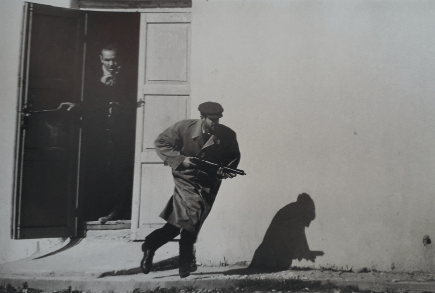
In 1958 we were living in Nicosia where English soldiers in their khaki uniforms filled the streets of this town. News reached us that there were troubles between Turks and Greek Cypriots. Our neighbour’s husband was killed by EOKA. What was worse, EOKA was targeting my father since he was an inspector in the police working for the British Government. Some things in life stand out sharply in the memory. I have such a precise memory of one particular day when my father came home with a worried pale-face. English helicopters were distributing leaflets against EOKA. I picked up a handful of leaflets and went to open the garden gates waiting for my father to come in quickly. I stood with my nose pressed against the garden gate of our house, which was situated in Kucuk Kaymakli. A young worried looking English soldier pointed his gun at me, hit my nose lightly to scare me and ordered me to go inside the house. As I started to walk towards the back of our garden my father drove in so I ran and quickly closed the gates. My father was shaking with fear and his face was very pale. His voice had a worried note as he explained how EOKA had set a trap to kill him.
My own trauma continued in the Turkish Cypriot enclave of Larnaca where we were forced to live in terrible conditions. In the beginning of 1964 this enclave was guarded by the Turkish militia surrounded by the Greek Army. We were overcrowded as many Turkish Cypriots came to live with us from the
surrounding villages. During 1964-1968 we were virtually imprisoned in this enclave. At one time when Greek Cypriots started shooting at the house we lived in I was shot on my left leg, which still hurts when I walk. It was a United Nations doctor who stopped the bleeding and saved my leg. This experience made me realise that we Turkish people would have perished without the presence of the United Nations peacekeeping force and without the political and military interference of the Turkish Government.
The food supplies for the Mackenzie enclave in Larnaca came by boat from Turkey. We were fed-up of eating only dried food such as beans, rice and lentils. Fresh fruit and vegetables were very rare. I decided to leave Cyprus as soon as possible and promised myself not to fall in love, as I did not want any obstacles getting in the way of me leaving the country.
In 1968 we were allowed to move out of the enclaves and pass through the Greek territory to visit other enclaves. It was in November 1968 that I managed to get out of Cyprus for good I have never wanted to go back.
In 2001 I revisited Cyprus and I found many people with different identities. As I write in 2016 this trend is particularly powerful. There are Turkish Cypriots who see themselves as brothers and sisters with Turkish people, there are those who feel superior to those who settled on the island from Turkey after 1974 and there are those who feel more Cypriot than Turkish. There are those who remain grateful to the Turkish military and those who see the Turkish military as an unlawful power. Soon there may be ‘secular’ and ‘religious’ groups as a result of the policies of the Erdogan Government. Turkish Cypriot students in universities segregate themselves from Turkish students from Turkey and sometimes this difference causes violence between the two.
CONCLUDING REMARKS Demetrios Hadjidemetriou
I have known Emine Ali (not her real name) for a long time and she is one of my oldest and dearest friends. Four years ago I interviewed her for a script I am writing with Frances Willson and Simon Fisher. The script of Shadows Beneath the Sun, tells the story of a missing soldier and his family and is written as a six part television mini series.
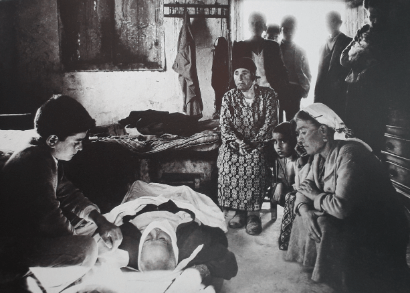
Emine’s story is important because as a young woman living through the events of the late 1950’s and early 1960’s her account brings to life what most books on the topic only cover in general terms. Usually this period of the history of Cyprus is described through what various political figures and organisations did or said and may even describe certain incidents and give some statistics. Very few however, show what it was like for a Turkish Cypriot family living in those conditions of fear, isolation and sheer terror during this period, especially after the events of 1963-4.
When Makarios tried to alter the 1960 constitution that established Cyprus independence with 13 amendments the end result was that Turkish Cypriot (t/c) civilians ended up surviving on a diet of dried food because in their isolation in tiny enclaves the only food supply came from Turkey.
When Makarios was pursuing the policy ‘of what is feasible’ (πολιτική του εφικτού), young women such as Emine were promising themselves not to fall in love because they were so desperate to leave the country they were not prepared to allow any obstacles to get in the way, even love.
In plain language Emine gives a vivid description of her childhood experience, playing with her best friends, oblivious to nationality or religion. As children, they formed their own language, a mixture of Greek and Turkish, shared their religions and enjoyed each other’s traditions and festivities. All they knew was friendship for each other. For ordinary Cypriot people this experience was the normal way of life and for centuries they lived next to each other as neighbours. When people have so much in common everything else pales into insignificance.
Born in the late 1940’s, Emine’s generation is probably the last to have these experiences and we are indebted to her for sharing them with us. But while, as innocent children, Emine and her friends played together, shared each other’s food and traditions, the dark clouds of nationalism in its extreme form were gathering momentum. This nationalism eventually grew to overwhelm everyone and changed everything.
Frances and I met with Emine again when we visited her on New Year’s Eve a few days ago. She told me that last summer she spent her holiday in Paphos with some of her family. She described how most Greek Cypriots (g/c) treated them as fellow compatriots but a small minority showed animosity towards them for being t/c. Right wing people do not see both communities as victims of nationalist hatred but
see the other community as the enemy, ‘the others’. On one occasion Emine with her family simply wanted to buy a watermelon from a street vendor only to be told to go to the other side. Emine’s family was not viewed as victims of the Cyprus tragedy like so many thousands of ordinary civilians from both communities, but as the enemy.
In Cyprus the true enemy is not the other community but nationalism, the ideology that turns ordinary people against another on the grounds of race. Both communities lost friends and relatives murdered in cold blood, both communities have their missing persons, both lost property and homes.
Let us be clear, the common pain should unite us and together with a loud voice we should say to anyone who will listen – never again war, never again fascism.


Keep writing. We need people like Emine to tell her story. I lived in a mixed village in the south a couple of miles from Louroujina for 25 years. My husband was TC. I’m divorced and live in Nicosia now. My children are TCs.
LikeLike